Thursday, April 29, 2010

April 29th, 2010: St. Catherine of Siena

Ever since I was an undergraduate at the University of California, San Diego I have had a deep devotion to St. Catherine of Siena. She is someone that I have always had deep admiration for and have found deep spiritual companionship with. She was born in 1347; a time that was challenging for women to be in roles of authority. Yet, because of her deep desire to seek God and truth, veritas, she found the strength and courage to speak truth to power when she noticed injustices occurring in front of her. For example Catherine, during the Avignon papacy, through letter writing, implored that Pope Gregory XI move the papacy back to Rome. Her deep spirituality and love of God guided her to move in the direction in which the Spirit was moving her.

As some of you might have already heard after serious discernment and prayer I have decided not to return as the Director of Campus Ministry with the Aquinas Newman Center for the 2010-2011 academic year. This prayerful decision was difficult. I truly enjoy working with the students. Yet I know deep in my heart and soul that God is asking me to trust Him to move on. These last four years at Newman have been a true blessing. I have truly enjoyed walking with the students on their journeys of faith; I see it as having been sacred time to minister with and for the students. I will miss them all tremendously, but, I am certain that God will continue to watch over them and guide them all. I do trust that through my discernment with God, I am being asked to move on, even though at this moment I am not sure what that will look like. I find strength in this moment not only in my relationships with God, family, and friends, but also in women like Catherine of Siena who trusted and loved God so much that she gave her life to Him. I hope that I can give my life as fully to God as Catherine did.

Tuesday, March 30, 2010

March 30, 2010: Sight


A barren island. This is the sight we encountered when we took an air boat on Tuesday, March 16th, 2010 to a barrier island on the North Shore of Lake Pontchartrain in Louisiana. What is a barrier island? A barrier island is an island that is a buffer for the land when hurricanes come through. These barrier islands, not only help as a buffer, they also have wildlife that live on them, therefore keeping the ecosystem of the wetlands alive and vibrant. Barrier islands in Coastal Louisiana are also called wetlands. These wetlands/islands are also important because they prevent flooding by holding water much like a sponge. As stewards of creation (Gen 1:28) we must be aware of what we are doing to our earth and attempt to remedy the wrongdoings.

The barrier islands of coastal Louisiana are slowly deteriorating. This erosion is occurring because of several factors such as: hurricanes, human made levees to direct the Mississippi River from flowing in its natural course, and the drilling of natural oil in Coastal Louisiana. To uphold the dignity of those living in Louisiana and to uphold the tenant of Catholic Social Teaching, Care of Creation, we should work with them in helping rebuild not only their homes and cities but also their land.

What can we do? This is where our delegation came in. The first two days we were in Louisiana were dedicated to sorting long grass and planting these bunches of grass onto a barrier island. The barrier island that we planted on was human made by dredging the bottom of a lake to the top of the water so to create an island. Even though this is an expensive process, to dredge, it is a necessary to create land so that both the city of New Orleans can be protected and that the ecosystem in the wetlands can continue to exist. When we arrived to the island it was barren. When we left the island on Tuesday late afternoon new life was planted (the picture on the top right of this blog entry shows the island with what we planted). Our group planted 6,600 small plants that day. We left and saw a big change both in what we did and in our hearts. It was a blessing that God was using us as His vessels to continue life in New Orleans.

Sunday, March 21, 2010

March 21, 2010: Touch


From March 14th to 20th, 2010, I was in New Orleans, Louisiana on a spring break service trip with college students from the University of New Mexico and resident parishioners from the Aquinas Newman Center. On Thursday night Jocelyn Sideco, the executive director of Contemplatives in Action (http://www.contemplativesinaction.org/), the non-profit that helped to plan our trip, led us in a evening of reflection. We had been having very deep evening reflections as a team, but this evening, Jocelyn gathered all forty of the participants staying at the location we were staying at for prayer. We lined up in four straight lines of ten. She had us stretch and then close our eyes. She had us reflect upon our senses and what we had experienced in New Orleans via our senses. The next few blogs will highlight a sense and give at least one example of how that heightened my experience of New Orleans.

Touch. On Thursday morning we went to the Lower Ninth Ward Village Community Center. Mac, a man who prior to Katrina stated that he was on the path towards living a very materialistic and self-centered life, post Katrina found his life worth living and decided to start up a community center so to be a beacon of hope in the Lower Ninth Ward. It was as if Katrina had cleansed his soul. From what I experienced, even though the community center was not completed, one could see that it was already flourishing as a center for change and hope to the community around it. One of the projects that we were put in charge of for the day was helping to dig up soil and to sift out debris so that the soil could be used to plant fruits, vegetables, and herbs. In the process we also were digging out the space where the garden would exist. Touching the soil and sifting it was a very holy and spiritual experience. As I sifted I prayed for the community of the Lower Ninth Ward. I prayed that this garden and community center would continue to elicit volunteers and bring the community together. I was standing and working in holy ground.

On a deeper level I also thought and prayed about the soil and its erosion in Louisiana. Did you know that Louisiana is losing about the size of a football field of land every 45 minutes due to erosion? (To learn about the land loss in Louisiana look at this website: http://www.americaswetland.com/) How will this affect all of us around the country? Why should we care? To name just a few things, Louisiana is one of the biggest port cities in the country, it is also one of the biggest manufacturers of natural gas, and it is one of the biggest producers of fresh seafood around the country. If coastal Louisiana is depleted the entire country will feel it. There was a study done that if just one of the approximately fifteen oil refineries in Louisiana were shut down, gas prices around the country would more than double. Not only should we care about Louisiana because our pocket books might hurt or because we might not have as much seafood to eat but we should care because of the people and the culture that reside in Louisiana. Imagine your home being wiped away by a natural disaster or by erosion. I think of my home state of California. I have thought about how I will feel when a huge earthquake, known to Californians as the big one, will strike and change the way California looks to me today. My family is there. My best friends are there. All of my memories from when I was born until I was 26 are in the state of California. To uphold the dignity of those living in Louisiana we should work with them in helping rebuild not only their homes and cities but also their land. (In a later blog I will discuss how we can help re-build the land.) Soil is a source of life and is sacred.

Wednesday, March 10, 2010

March 10, 2010: Rice Bowl

"They will know we are Christians by our Love." Today I heard a speaker, Thomas Awiapo, speak upon his experience with Catholic Relief Services (CRS). The first sentence I wrote was how he started his talk; a Catholic hymnal. He spoke of the beauty of his country, Northern Ghana, the moon, the simple things like brushing ones teeth with twigs, and the tragedies of poverty such as hunger. Mentioning that poverty and riches can both be beautiful and difficult; that we must live in harmony and not in constant struggle with the powers that be. Thomas did not know his parents. They passed away before he could remember. He was left with three brothers. They would cry a lot because they were so hungry. He talked about how at times the four of them would crowd over a small bowl of food and fight over it; survival instinct. He saw two of them die of hunger right in front of him. Then one evening his older brother said to him that this life was too hard, by the morning, his brother was gone. He was alone and hungry. One day he smelled some food being cooked not too far away. He walked to the food and it was a school that was built by CRS. They were enticing kids to come to school by giving them a snack and a hot lunch; both of which were provided by the project Operation Rice Bowl. He went to school not because he wanted to learn but because he wanted to eat. Thomas stated that he would sometimes try and trick the teachers in giving him the snack without having to learn. But CRS and the teachers they hired were too smart. Eventually Thomas, due to the snack, graduated from this school then went as far as going to get his masters in California. He now has a family and is working for CRS. He sees the value in education and how being educated can help people empowered so that they can get themselves out of the cycle of poverty. Thomas now works at creating systems to get people out of poverty in his country, for example, building schools for kids to become educated and eat. Because people donated money through CRS, specifically Operation Rice Bowl, Thomas was able to come and talk to us about his experiences. What this experience left me with was the necessity for the sense of giving. Working in the Church, I don't make a salary that gives me a lot of flexibility in how I spend. However, hearing the story of Thomas today has empowered me to give out of what I don't have. I don't mean that I am going to go in debt giving to people who need it. What I mean is that I will give up something I want to give to someone who needs. I am living in wealth, whether I realize it or not, and others are barely living. Giving from a place where it might hurt a little bit for me will help someone eat and survive.

Sunday, March 7, 2010

March 8, 2010: Saint of Second Chances

St. Dismas and Jesus

On Saturday, as part of the Newman Justice Walking group, we went to Dismas House. Dismas House, as mentioned in another blog, is a home for motivated people who are on parole and probation to successfully transition into society. While we were there one of the social workers told us who the patron of Dismas was. Although not a lot is known about St. Dismas the little that is known is powerful. St. Dismas was the man crucified next to Jesus in Calvary. He repented to Jesus before he died and then Jesus said, "Amen, I say to you, today you will be with me in Paradise" (Lk 23:43). This penitent man is therefore known as the saint of second chances.

About fifteen minutes into eating lunch with the residents of Dismas House a man came in and sat right in front of me. Outwardly he seemed not put together. I judged him immediately. Then he started to eat. He ate as if he had not eaten a meal in days. Food was flying everywhere. I judged him again. After this second judgement I sat back in my seat and asked myself, "if I am called to see Christ in front of me all of the time, what do I need to do to stop judging and be more compassionate?" I started to ask him questions. He told me he had been in the house for two weeks. He also said that he was college educated. We did not get into a deep conversation but I did recognize that I prejudged. I must attempt to go into every experience with a beginners mind; a mind that is not placing judgements or presumptions rather a mind that sees things simply as they are. A beginners mind does not block Christ midst in front of us. This man in front of me that day, like St. Dismas, was on the road to his own salvation.

Thursday, March 4, 2010

March 4, 2010: Justice Walking

An image I took from a housebuilding trip to Juarez a few years back with UNM college students.


Below is an article I wrote for the People of God, the Catholic Archdiocesan Newspaper for the Archdiocese of Santa Fe. It will be published in April.

College Justice Walking: A Journey of Faith and Transformation

Do you know what Catholic Social Teaching is about? Catholic Social Teaching has been said to be the best kept secret of the Catholic Church. Twelve students at the University of New Mexico’s Aquinas Newman Center are embarking on a journey to learn and live the Church’s social teachings with a program called College Justice Walking. The Newman Center has been asked to be a pilot group for this program in the country. This seven week series, including an opening and closing retreat, opens up the rich treasure of the Church’s social teachings through prayer, praxis, and the educational components of reading, the bible and supplemental books, and discussion. These students will be learning the tenants of Catholic Social Teaching and how to integrate these tenants into their daily lives.

One of the elements of the Justice Walking program is that the participants volunteer at one location four different times so to build relationships amongst those whom they are serving. The group from the Newman Center will be volunteering at Dismas House. Dismas House is a home for motivated people who are on parole and probation to successfully transition into society. The group will be cooking and serving a meal to those in need. These bonds allow the participants to become more compassionate in the face of our suffering God and will therefore help to transform these students to make even more compassionate choices in the future.

The Justice Walking leaders manual provides some provoking questions of the students, “What would happen to our lifestyle if we tried to live out the Gospel teachings together? What would happen to our friendships if we let the Gospels guide us? If we put God’s justice first, what and who would we care about? What would we be looking for in life?” One of the main teachings of Jesus is the following, “For I was hungry and you gave me food, I was thirsty and you gave me drink, a stranger and you welcomed me, naked and you clothed me, ill and you cared for me, in prison and you visited me… whatever you did for one of these least brothers and sisters of mine, you did for me” (Matt 25:35-36, 40). Justice Walking forces participants to look critically at their lives and what the Gospel calls us to be. The hope with this program for the students at Newman is for them to finish the Justice Walking program more compassionate in their actions and more active within the realm of social justice in whatever career they decide upon. Please pray for the students embarking on this journey of faith. This journey will break their heart so that they can fall in deeper love with the body of Christ and the face of God.

Sunday, February 28, 2010

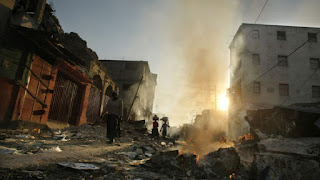
Feb. 28, 2010: Haiti & Chile, Our Response


People walking in rubble in the market area in Port-Au-Prince in Haiti on Jan. 18th, 2010
Picture taken from the Internet

Yesterday I was watching a documentary on Canada's response to what happened to the United States on September 11th, 2001. Within two hours of the time that the second plane hit the second tower in New York City all of the airspace in the United States was closed. Every plane in the United State was on the ground. This meant that the planes that were flying to the United States over the Atlantic Ocean, whom could not turn back to Europe, had to continue on their air route but be redirected. Most of them were directed towards Canada. The documentary focused on the city of Gander. Gander in on an island named Newfoundland on the far East of Canada. The city of Gander has a population of 10,000 people. NAV Canada, the equivalent of the United States FAA, redirected 239 air crafts to Western Canada. On September 11th, 2001 the city of Gander, within hours, received 39 redirected jumbo jets, carrying some 6,600 passengers. Imagine the city you are currently living in almost doubling in size in a matter of hours! The city of Gander did not have enough hotels to house people so they as a city opened their churches, schools, and gathering hall doors to the new influx of people. They came together as a community and fed people. They opened their grocery and clothing stores free of charge to the people who were stranded and distressed about what was going on in their country. The city of Gander, for two days, was a safe haven for people in the face of a national disaster. The city of Gander needs to be an example of how people should respond in the face of fear, disaster, and hurt. We need to have an open heart to Christ whom is present in front of us.

How should, we therefore, respond in the face of natural disasters around our world? Yesterday, Chile was hit with a 8.8 earthquake. For those of you who do not know what an earthquake feels like an 8.8 is a huge earthquake. The largest earthquake I have felt in California was in 1994. The earthquake was a 6.7, centered in Northridge, about 50 miles away from my hometown of Oxnard. On the earthquake scale each .1 multiplies the shake by 10. The 6.7 I felt shook my entire house, things were knocked off of the walls, electricity for a short amount of time was not working and I was so scared I ran into my parents bedroom. I cannot imagine what an 8.8 earthquake would feel like. The advantage that Chile has is that economically they are more sound than a place like Haiti. Also, since 1973 Chile has had 13 tremors greater than 7.0, their government has forced builders to adhere to rigorous building codes. However, regardless of the socioeconomic status and the preparedness one has for earthquakes the people of Chile need our prayers and whatever we can give in aide.

What about the people in Haiti? How are they doing after their 7.0 earthquake? The country of Haiti is a much different scenario when it comes to how well they were prepared for natural disasters. Haiti is the poorest country in the Western hemisphere. Its infrastructure is bleak and its government (from what I have read) is corrupt. I have a friend who just got back from doing some relief work in Haiti and he said it was one of the most powerful yet difficult things he has done and seen in his lifetime. At the end of March the United Nations in New York City will host donors in a discussion to formulate a plan on what the next steps they will take to help the people of Haiti in their recovery. However, I wonder if the end of March will be a little too late. The rainy season in Haiti begins in March. With all of the rubble and the uplifted soil flooding is not merely a concern it is going to occur. What are the Haitian people going to do? From my studies I know that countries cannot be fixed by outside countries. People from within need to make the changes. Power and money from the outside are only temporary fixes. The nation and its peoples need to come together to build their country. And honestly I trust that the people of Haiti have already begun this journey. They will make their country viable and sustainable. Where there is death there is a resurrection. However, I am not going to pretend I know all of the answers. I don't know much of Haitian history or politics. And poverty in general is something I don't quite understand or fully grasp, even though I have seen it face to face. Intense poverty, like that of Haiti, is complex, and attempting to fix that deep of an issue perplexes me. My heart and prayers go out to them. However, in the face of this issue, what should our response be? Again, my mind goes back to the way the Canadians, post 9/11, treated us. How can we be hospitable and loving in a time of deep grief, sadness, and disaster? From what I have learned donating money to Catholic Relief Services, Jesuit Refugee Services or similar organizations seems to be the most helpful. If there is a money transaction the nonprofit organisation can purchase what they need over in the country of disaster, or at least closer to the point of destination, without or with little cost in shipping. At the Aquinas Newman Center in Albuquerque there is a woman, Deborah Thomas, and a group of volunteers who call themselves, "Comfort for Haiti's Children" whom have made and received donations of blankets to send to the children of Haiti. They have sent over at least 100 blankets with delegations headed to Haiti. However I know they are in need of funding to send these blankets. If you can make a donation please email Deborah at adthomas74@msn.com. These are two ways in which you can help the people of Haiti. It is obvious that this country still needs our support and prayers. What are you going to do when you see Jesus in front of you?

Help for Haiti: Learn What You Can Do

Journey of Connection and Discovery in Guatemala: A Transformative Experience with Unbound

Embarking on a journey to Guatemala with Unbound was more than just a travel experience - it was a profound exploration of compassion, comm...