Sunday, August 11, 2024

Journey of Connection and Discovery in Guatemala: A Transformative Experience with Unbound

Embarking on a journey to Guatemala with Unbound was more than just a travel experience - it was a profound exploration of compassion, community, and personal growth. From the moment we landed in Guatemala City, the warmth and hospitality of the people we met were truly heartwarming.


Arrival and First Impressions

I embarked on this trip with an open heart and no preconceived expectations. My primary excitement stemmed from a desire to learn more about Unbound and to meet the children we support educationally. Having visited Guatemala two decades ago, I was already familiar with my deep affection for the community and culture.


Arriving at the opulent Barcelo hotel was a striking contrast to the reality of poverty we were about to encounter. This initial impression underscored the vast disparities we would soon explore. The first evening, guided by Yovaney and the Unbound team, set the tone for what would be an extraordinary journey. Dinner with the Unbound staff revealed their unwavering commitment and the profound sense of community they cultivate, establishing a foundation of understanding and connection for the days ahead.


Immersive Cultural Experiences

Our journey took us from the bustling Plaza of Guatemala City to the tranquil heights of Acatenango. Every community we visited embraced us with open arms and warm hearts. The reception in Acatenango was particularly breathtaking - rose petals strewn on the ground, vibrant fireworks, and traditional dances created a festive atmosphere brimming with gratitude and celebration. Initially, I felt a bit overwhelmed by this grand welcome, feeling undeserving of such honor. My family and I sponsor these girls, and the financial impact on us is minimal. However, I soon realized that this heartfelt reception was not just for us but a collective gesture of thanks to all who support the 60,000 young people in Guatemala. It was a profound reminder that while only 1% of sponsored children ever meet their sponsors, the collective impact of this support is deeply valued.


Watching Sofia play with local children and receiving a flower from one of them was a poignant moment, illustrating the universal and simple joys that bridge cultural divides.


In Santo Tomas la Union, we encountered Unbound’s transformative Poverty Stoplight program. This initiative empowers families to evaluate their own living conditions through self-assessment and goal-setting. This innovative approach not only addresses poverty but also instills a sense of autonomy and hope, enabling families to take control of their futures and create tangible improvements in their lives.


Personal Connections and Reflections

Meeting our sponsor children was the heart of our trip. Alba and Maria Belen were not mere beneficiaries; they emerged as beacons of inspiration. Alba, despite facing academic challenges, harbors a profound aspiration to become a teacher. Her journey is marked by resilience as she navigates the recent loss of her grandparents and the abandonment by her father. Her determination, supported by her family, is a testament to her strength and hope for a better future.


Maria Belen, with her dream of becoming a doctor, radiated intelligence and perseverance despite a demanding home life. Her commitment to her studies and her aspirations stood out as a powerful example of courage and ambition.


During our time in Guatemala, our family felt compelled to deepen our involvement by sponsoring a third child. Meeting seven-year-old Hermine and her family offered us a poignant glimpse into the daily realities faced by those supported by Unbound. Hermine’s story, alongside those of Alba and Maria Belen, underscored the profound impact of our support and the enduring spirit of the children we have the privilege to help. Honestly, experiencing the Eucharistic Congress a few weeks ago, I do know that this is a direct manifestation of our experience of the Eucharist and sharing God’s love in our world. 


Our interactions with these incredible young people, their families, and their communities brought the essence of Unbound’s mission to life. It was clear that the support from sponsors like us is not just financial - it’s an emotional lifeline that helps them aspire, achieve, and transform their futures.


A Movement of Love

This trip underscored the essence of Unbound as more than an organization; it’s a movement of love and support. The interconnectedness between sponsors, sponsees, and the community through small CODI (Communities of Integral Development) groups is reminiscent of the profound companionship between Jesus and his disciples. It also reminds me of the trinitarian love of our Father. This experience was a powerful reminder of the impact of accompaniment and the shared commitment to uplifting others.


As we returned home, the memories of the vibrant faces, the heartfelt conversations, and the shared moments of joy stayed with us. This journey through Guatemala wasn’t just about witnessing the work of Unbound - it was about becoming a part of it, connecting deeply with the people, and understanding the transformative power of love and support in action.

Thursday, April 23, 2020

April 23rd, 2020: My Reflections on Mass & the Eucharist during Covid-19

I wrote this note to some of our USC students. I hope this message can also be useful to you during this time when there are no public Masses. 
______________________________________________

Hi all,

Just want to share some of my reflections over this time of Covid-19 about Mass and the Eucharist.

I am an avid daily Mass goer. Ever since I was in college, the Eucharist has been central to my relationship with Christ. There are times that I remember that the Eucharist was my sustenance, such as when I did a year of volunteer work with migrants in El Paso. I craved the Eucharist so badly during that year, that I found a way, whether I walked or used the community car, to get to the closest church for daily Mass. 

This time of Covid-19 has been very difficult for me when in comes to my relationship with God in the Eucharist; simply because I do not have access to receiving the Eucharist. The night the Archdiocese, and then the staff at the Catholic Center, shortly after, decided that we could not celebrate public Masses, I went to my husband and tears started to roll down my face. 

I have not missed a Sunday Mass, but I had stopped attending daily Mass. The distance between me and the Eucharist was too much for me to bare. When I tried, tears would well up. There is a deep longing for Christ in the Eucharist that I still have. I have been privileged in that this is something I have never had to worry about in the past.
Picture of students and staff
at the USC Caruso Catholic
Center on Ash Wednesday.

Then God, through Fr. Richard and Fr. Joe, challenged me. The recognition and remembrance that at Mass, Christ is present in (1) the priest, (2) the Word, (3) the community, and (4) the Eucharist is important. For me to not attend Mass was denying myself the grace of God in these three areas. In a typical human fashion, I was not allowing God's grace to continue to imbue me through the Mass. I was hung up on not receiving Him through the Eucharist. I was reminded at how consumeristic this felt - if I can't have the Eucharist, physically, then I am not going to partake in Mass. And I was literally getting in the way of God and the grace He wants to give me. Last week I started attending Daily Mass with the Catholic Center again. The Word of God, the homily given by the priest, and the community have really spoken to me in ways I have needed to hear God. 

This message is being written to students who I know were typical daily Mass goers at the Catholic Center. I am not sure what barriers you are having in your own life that is preventing you from attending the Catholic Center's daily Mass; maybe there are no barriers and you are attending daily Mass. But know that if you are struggling, you are not in this struggle alone. I have been there and am still continuing to struggle. However, being the person that is always attempting to improve herself for Christ, I know that Mass and the Sacraments are God's and the Church's ways for us to receive His grace and peace. I knew I had to get over my own barrier to get closer to Him.

Also the prayer of spiritual communion has been a life-line (read the prayer below). I have this prayer posted on a virtual post-it note on my computer. I pray this prayer throughout the day, telling God how much I miss Him. This is yet another way that I am satiating this yearning. He knows my desire to be with Him and there is solace in that.

Lastly, Tricia wrote this reflection on the Road to Emmaus (this Sunday's readings) for small group bible studies. She parallels her reflection with Mass. Its wonderfully written. My small group bible study got a lot out of it last night. Feel free to check it out. 

Anyway, just thought I'd share with you my thoughts about Mass. I hope in some way this has been helpful for you as you continue to grow closer to Him during this season. Feel free to reach out to me if you want to talk more. Also feel free to forward this to others that you think might need to hear this. Know that I am praying for you every day. I miss ya'll!!

Peace,
Rosie

Spiritual Communion Prayer
I wish, my Lord, to receive you
with the purity, humility and devotion
with which your most Holy Mother received you; with the spirit and fervor of the saints.
Amen.

Tuesday, January 7, 2020

January 7th, 2020: Ministering from the Heart of God

Last week at SLS 2020, a Fellowship of Catholic University Students (FOCUS) conference, I was asked to be part of a panel on ministering from the heart of God. On this panel we were asked to discuss how we, as professional campus ministers, continue to deepen our pursuit of God's heart in the midst of ministry. After the panel concluded several campus ministers asked me to give them the nine points I described while I was on the panel.  

(1) Stay rooted in our identity as a daughter/son of God. I am in continual discovery of my relationship with God. It's like any relationship, we cannot know God fully, it takes spending time with Him on a continuous basis. When I reflect upon my identity as a daughter of God there are several instances that come to mind as my identity has been formed. When I was an undergraduate student at UC San Diego I entered university without an active relationship with God. Because of a friend's relentless invitation I decided to join her for Mass. After my experience of community and Christ in the Eucharist I was compelled to deepen my relationship with Christ. In particular, there was a priest, Fr. Mark, who within the first few weeks of my arrival into the community, when distributing the Eucharist, said to me, "Body of Christ, Rosie." I felt seen, known, and loved by both the priest and also Christ. This for me began my journey in understanding my identity as a Child of God. Coming back to these moments of clarity in our identity as children of God is important as we continue to unpack this crucial relationship.

(2) Going to the Sacraments often has been pivotal in my staying rooted in my relationship with Christ. Going to Mass daily grounds me in what's important and focuses me on Christ, whom is my compass, companion, and inspiration. Find a way to make this a daily habit. I enjoy going to Mass first thing in the morning. It starts my day off right, with Christ at the center.

Motherhood has also deepened my devotion to the Sacraments. This last year my daughter went to the Sacrament of reconciliation for the first time and also received her first communion. Both of these experiences have convicted me, in an even deeper way, about the centrality of our ministry and faith in the Eucharist and the Sacraments. And it doesn't hurt that after her first communion she said to me, "Mami, I want to receive Jesus as often as possible, just like you." My heart was filled with joy. 
(3) Study. God gave us a mind so that we can come to know Him through study. Read spiritual and theological books. I currently read Christis Vivet and am currently reading a book called Move about evangelization in Evangelical churches. Soon I will also be reading Pastores Dabo Vobis as the team at USC unpacks formation and what that looks like in college students lives. Reading and learning, using our intellect, will help us to know whom God is more robustly.

(4) Work out. Take care of yourself physically. I run. Running clears my minds and is a form of prayer. I am able to center myself on Christ in the midst of running. Working out de-stresses me and allows me to be whom God created me to be. Holistic self care (mind, body, and soul) is important in the spiritual life.

(5) Spiritual direction. Find a good spiritual director and meet with him or her regularly. Also surround yourself with good friends whom can journey with you. My husband and friends are incredible people who support me and also challenge me to be a better minister.

(6) Go on an annual retreat. Lay ministers do not necessarily have this written into their job descriptions. If it is not in your job description, advocate for yourself and your relationship with God. Going on an annual retreat is important for your spiritual life and the spiritual health of your ministry. As I have matured in my relationship with God I have found silent retreats are what I crave the most. Listen to what type of retreat God is calling you to do and take the bold step to actually do it. Going on your own retreat also shows that we as lay ministers are practicing what we preach to our students. 

(7) Go to conferences where you will be spiritually fed by Christ and other professional ministers. Attending SLS 2020 and going to Catholic Campus Minister Association Conferences (CALLED 2020) are spiritual injections that gives me a larger vision of the army that God has created on earth to do His good work on college campuses across the country. Coming together at these conferences builds us to be equipped spiritually and pastorally so we can help uncover Christ's presence in the lives of our college students.

(8) I do not know all that there is to know about God. I allow our college students to help me deepen my relationship with God. Sometimes students ask me questions that I don't know how to answer. Or sometimes I see God moving in a students life that astounds me and helps me to see His love and compassion in a deep way. They show me who Christ is all of the time. Be open to it.  

(9) Take breaks. Use your vacation time. When I first started in ministry I never took vacations. This lead to burn out. Take your days off and take vacations. I promise you this will help center you, deepen your faith, and you'll come back to the ministry that God has entrusted you with, with more creativity and vigor. 

I feel so blessed that God has entrusted me and continues to call me into this ministry. When you do God's work, and through His grace, as it continues to succeed and more disciples are formed, the devil will want to try and mess with God's plans. Keep Christ at the center. Keep looking at Him. Daily I pray the prayer to St. Michael. Staying rooted in ministrying from the heart of God is both liberating and invigorating. 

I live by a quote from St. Catherine of Siena, "Be whom you are called to be and you will set the world on fire." We are called to be His daughters/sons. We are created to be in a dynamic relationship with Him. Abide in this relationship that will challenge and sustain you.

Sunday, August 7, 2016

August 7th, 2016: Faithful Citizen

The Stephen Colbert Report recently had a parody of both the Democratic National Convention and the Republican National Convention in relation to the Hunger Games.  The political bantering I have seen from both of these parties feels like a reality tv show, with no obvious choice of who is the best or most qualified candidate to trust.  Perhaps the lense in which we are looking at these presidential elections needs to shift from the candidates to the principles they embody.  Let me be clear, no political party embodies Christ and His teachings.  We must remember that we need to be Catholic first and should vote as Catholics, not by our political leanings.  What does this mean?  Faith and intellect are important components to this question.  Faith and intellect help to form our Christian conscience (Gaudium et Spes, 16).  We must pray to God for clarity and we must engross ourselves in the knowledge of what the Church teaches.  Catholic Social Teaching and the document Forming Consciences for Faithful Citizenship from the United States Conference of Catholic Bishops are two ways we can begin to form our conscience.


Besides the presidential elections we must also read and pray about the ballot measures.  These ballot measures will have immediate effects on the way we live.  

Some might wonder why the Church is entering into the political sphere.  Our faith cannot be limited by what happens inside of the Church walls.  If we only focus on what happens in the Church and do not integrate Christ’s message in the world, this creates a Church that is both irrelevant and ineffective.  Our faith must be integrated into all that we do, and this includes politics.  The Catholic voice is a strong one.  Every election is an important election.  We must vote.  Don’t sit this one out.  We must be faithful citizens.      

Tuesday, September 24, 2013

September 24th, 2013: The Children of El Salvador

A week and a half ago I watched a movie called "Voces Inocentes/Innocent Voices".  The movie was made in 2004, 12 years after the civil war in El Salvador ended.  Voces depicts the story of children during the Salvadorian civil war (1979-1992).  During the civil war children, especially young boys, not fully understanding what was going on, had to choose an allegiance - either to the guerrillas or to the government army.  Neither group was free of violence.  To see the depiction of the thought process and emotions of these children stretched my mind.  Prior to becoming a mother I had read about child soldiers in Africa, but for some reason that was a bit intangible for me - both because I had yet to have a child of my own and because I have never been to Africa.  Something about going to El Salvador, understanding its history a little bit more, and being a mother, has given me a deeper understanding of the complexity that still lives in the minds of these children whom now are adults.  I recommend watching this movie if you want to better understand the history of El Salvador.

I am going to share some facts that were shared with me regarding cost of living and a little bit about the social reality in El Salvador.  A family of four, just for food, needs approximately $170/month.  Textile and factory workers make approximately $190/month.  Farm workers make approximately $100/month.  Those with professional degrees make between $600-$700/month.  For a family of four to have a modest living they would need to make about $700/month.  80% of all earnings goes towards commercial buys - such as clothes, food, and rent.  The other 20% goes towards healthcare and education.  Many families are single parent homes.

While in El Salvador I interacted with many children.  On Monday, August 5th our group visited a
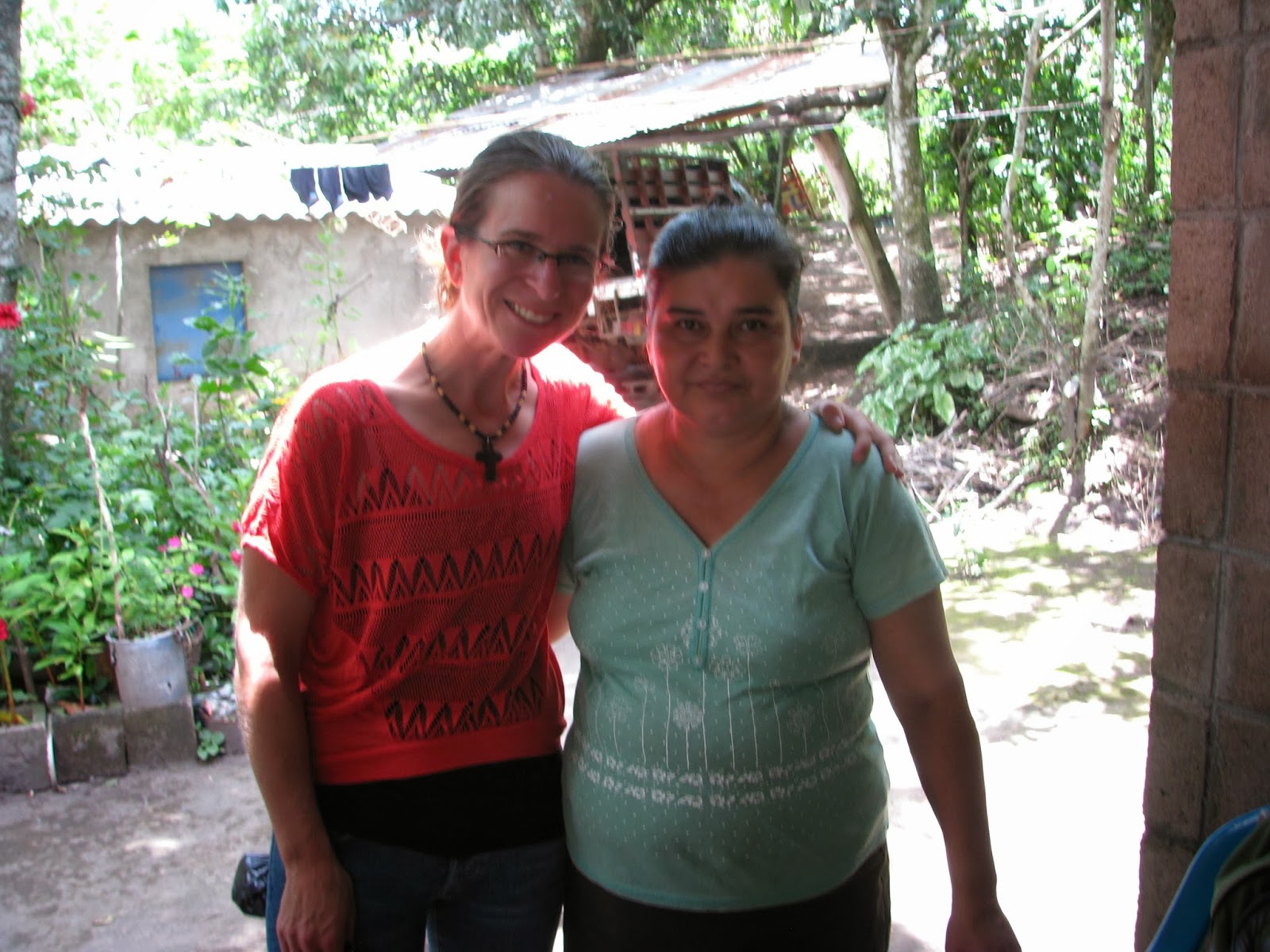
Me with a mom of a scholarship student.
community, Las Delicias, a small campo, a semi-rual area, of 600-700 people, with urban problems, 45 minutes outside of San Salvador.  In this community people make about $4-$5/day.  If they can find work in nearby factories they can earn up to $190/month.  In this community there is one elementary school, and it is free.  However, to attend school students must have a pair of shoes and supplies for the academic year, which equates to $60 a year.  Many of the children do not attend school due to financial constraint.  There is no high school in Las Delicias.  For children to attend high school its approximately $400/year, which includes the cost of bus transportation from Las Delicias to the high school in the neighboring area.  For most of the families in the area high school is not an option therefore making college even less attainable.            

Yet there is so much hope in Las Delicias!  Here we visited one of the Maryknoll Lay Missioners sites.  Larry, the missioner works with  FUDESCA: Fundación para el Desarrollo y la Solidaridad Cástulo Antonio (FUDESCA).  This organization works on several projects, some of which include, scholarships for youth attending elementary and high schools  and young adults attending college, soccer teams - where their motto is Dios, Estudios y Deportes, computer classes, a small library is accessible to youth to read and study, jewelry making, art classes, and even a break-dancing team!  I was struck by the diversity of the programs for the youth.  Since gangs infest the streets of El Salvador it is necessary that children have healthy and life-giving alternatives - such as school and activities, like those provided by FUDESCA.  While there are barriers to overcome the poverty I saw in Las Declicas, I truly felt a sense of hope visiting this small community.
With children in La Esperanza.
The day that has had a lasting affect in my heart is Tuesday, August 6th when we visited Maryknoll Lay Missioners, Rick's site, in La Esperanza, a squatter settlement along El Salvador's abandoned railroad, 20 miles East of Cojutepeque.  During the Salvadorian civil war people fled the San Vicente area and basically squatted around these railroad tracks.  This area was probably equivalent to the worst poverty I have seen in my life - most people in this area don't have a title or own the land they live on and basic services are extremely limited - if at all existent.  Walking along side the railroad track down a dirt road one can smell the raw sewage.  We entered a small one room building - a multi-purpose chapel space - built by a base community in the area.  Here catechesis for adults and the ministries of taking care of the sick and distribution of food takes place.  In this same room children play and learn English.  Rick also works closely with the older children in the area helping them become promoters of literacy in their community.  There is no school in La Esperanza - the closest is in Cojutepeque.  Upon seeing the conditions and hearing the reality I gave everything I could to the children that surrounded me - pens, paper, rosary, a cross...everything.  I knew this "stuff" was not going to fix anything.  I knew that our visit was not going to change their reality.  But I attempted to love them in the moment.  And they have created a lasting affect in my heart and soul that cannot be removed (as I type I cry).  Retrospectively looking at the situation I now remember Rick telling us, that they never have visitors, and that our presence showed these children that they are valued and loved.  I hope I loved enough that day.   

I know we all left with heavy hearts because we know that many of these children face terrible odds of overcoming the barriers that hold them back.  This community moved my heart.  These children changed my soul.  One cannot see this reality and come back the same person.  Tonight as I was driving home and was talking to my dad on my cell phone I told him - I am too comfortable.  I said, "Papi, I just drove 60 miles - back and forth to work - how can I be okay with this when the children in El Salvador do not have access to go to a school that is 20 miles away from them?"  While I am unsure of where this experience is going to lead me and my family, I know, in the depths of my heart that I am not the same person I was before I left to El Salvador.              

In 2011 the Universidad de Centro America (UCA), a university run by the Jesuits in El Salvador, did a study asking the question, is El Salvador a country for youth?  The study concluded that due to the gang prevalence and violence, it is not.  I did learn, however, that there has been some strides of success in disarming the violence created by gangs in El Salvador.  Time magazine highlights a truce that has been made between two of the most powerful gangs in El Salvdor in an article written in 2012 (Gang Truce).  The sense that I got was that some people believe the truce is working because homicides in certain regions have lowered.  People are grateful that the truce - not more violence - is actually lowering the number of deaths.  However, some people are very skeptical that the truce is actually working.  They believe that the reports on the numbers of homicides are skewed.

Overall I am left with more questions than answers.  What is my role?  What can I do?  I received an email from Rick a few days ago with two notes from two children in his community asking me to write a letter and send pictures to them.  I knew, without thinking, that I was going to respond to these children.  Besides my long distance love of the children of El Salvador - what else am I called to do?  How am I being called to share the story of the children of El Salvador?    

Monday, September 2, 2013

September 2nd, 2013: Water, Gang Violence, Parque Cuscatlán and El Rosario Church

We were told that El Salvador is doing 50% better than all of the countries around the world and 50% worse than all of the countries around the world - when it comes to poverty, violence, education, health care, and access to resources.  We also learned that 90% of all of the drinking water in El Salvador is contaminated, therefore to have clean drinking water, people, if they can afford it, need to drink bottled water.  Many people in El Salvador do not have this luxury.  We visited many people that had a spout where water comes out of.  Depending on the community sometimes the water comes out of this spout one time every other week or one time a month.  Unfortunately those who have this spout have to constantly keep a bucket under the spout because they do not know the exact day and time the water will spring forth - and this water is not clean drinking water.  I have noticed that many developing countries I have visited have a scarcity of clean natural water.  Not having access to clean drinking water creates many health problems which can lead to other issues such as malnutrition, illnesses, inability to work or focus at school, and dehydration.  What are we going to do globally as the issue of access to clean drinking water becomes larger?  What are we doing now to save the water that we do have?       

Gang violence is very prominent in El Salvador.  This explanation on gang violence in El Salvador will be simplistic but will help my readers understand how the gang problem began.  Due to the civil war and the common "push and pull" effects of immigration [push factors such as poverty, conflict and disaster, pull factors such as employment, public benefits, and family members that might already be in the country migrants are attempting to get to] an estimated 1 million people, left El Salvador.  Many migrants left with their children.  Some people ended up in major metropolitan cities such as Los Angeles.  Work was scarce and many people who migrated to the United States continued to struggle.  Even though they were living in a more developed country the migrants were still living in poverty.  For the same reasons many American youth enter gangs, the young babies that left El Salvador - without a memory of their home country - now found themselves as young adults and were looking for protection, an identity, recognition, fellowship, and eventually became part of the gang culture.  Due to the nature of criminal gang activity in the 90s many of these gang members were arrested and then since they were not U.S. citizens they were deported to El Salvador.  "In the last 12 years, U.S. immigration authorities have logged more than 50,000 deportations of immigrants with criminal records to Central America (Maryknoll information packet)."  These young men, did not speak Spanish, did not remember their home country, and learned about gang violence in the U.S., and therefore when they returned to El Salvador this created a tight network of gang culture in El Salvador.  To this day gang violence is active.  The two main gangs in El Salvador are Mara Salvatrucha (MS-13) and the 18th Street gangs.  The gangs not only affect violence but also affect the children of El Salvador, in that children are the ones recruited to join these gangs.      

One thing that struck me while we were in El Salvador was the prominence of guns.  Outside of every store - big or small, outside of churches, and sometimes even homes, every one had a security guard with a gun.  Coming from a place in California where violence is not in my face all of the time, this was hard for me to see and be around.  Are the guns used for intimidation?  Security?  Or perhaps a subtle reminder of the blood of the war and a reflection of who truly is in charge?  I don't know.  The civil war ended 20 years ago, but I still think the effects of the war, in the living memory of those who are there, is still very real.  I am unsure of what Salvadorians think about the presence of guns everywhere, but I know that for me it was jarring and something I could not ignore.       

Two things about traveling in El Salvador that I truly miss are the notion of time and affection.  In the United States we are addicted to our cell phones and looking at our watches.  We must be efficient and timely to fit into American society.  The notion of time seemed to not exist in El Salvador.  It allowed me to be present to those I was interacting with in a more intentional way.  One of the things that I experienced once I came back from El Salvador was the reverse culture shock of not hugging people and kissing them on the cheek.  In El Salvador every person I met I hugged and kissed.  This is very common in Latin American countries, so it is something I am very used to, since my family is Puerto Rican and Cuban.  When I got back to the United States and people were "stand offish" and needed
Mike at Parque Cuscatlán
personal space I struggled.      

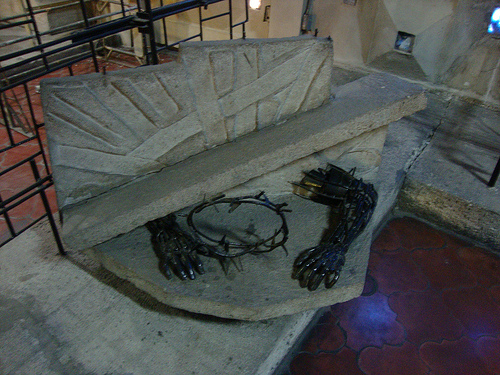
El Rosario Church - Stations of the Cross
On Sunday, August 4th we went to Parque Cuscatlán, mass at El Rosario Church, and we spent some time praying at Romero's tomb in the Cathedral.  In Parque Cuscatlán we saw a memorial wall with 43 panels where those killed or disappeared are remembered.  Then we went to El Rosario Church in San Salvador.  From the outside the Church didn't look like much but once inside you could tell it had a post-Vatican II feel - the seating was unique, the natural light and stained glass was beautiful and the stations of the cross were made with rod iron in a very contemporary rendition.  While I don't remember the exact preaching the priest said that day, I do remember the Dominican friar preaching about distribution of wealth and making sure that we not only take care of ourselves and those in our immediate families but also those whom might not have the same resources that we do (Luke 12: 13-21).  His preaching was poignant and challenging.    

Just outside El Rosario is Plaza Libertad.  During the civil war on October 29th, 1979 there was a massacre in this plaza - campesinos (people from the country) were peacefully protesting the oppression of the government in the plaza and the military opened fire.  People ran for cover in El Rosario Church.  Those running into the church brought bodies with them in hope of either burying them or attempting to resuscitate them.  Once the church was full the doors were shut.  You can still see bullet holes in the church doors.

bullet holes in the door
Twenty-one people died attempting to get into the church.  The people who made it into the church had to stay in there for a few days until Archbishop Romero finally convinced the military to back off.  Due to this waiting period, and the smell of dead bodies in the church, the people whom survived decided to lift up the tiles and to bury the dead.

My next post will focus on my experience of the Catholic Church in El Salvador and Monsignor Romero.  

September 2nd, 2013: Santiago Nonualco

Ever since my trip to Peru, Bolivia, and Argentina in 2008, Maryknoll Lay Missioners (http://www.mklm.org/) have been in my heart.  The core values of of the missioners: Gospel values, option for the poor, conversion, witness, crossing cross cultural boundaries, community, forming ecclesial teams, and building bridges with the U.S. church, really resonate with me.  This particular trip was sponsored by both Maryknoll and JustFaith Ministries (http://www.justfaith.org/).  Maryknoll Lay Missioners were the main tour guides for us while were were in El Salvador.  Maryknoll has been in El Salvador for almost 50 years.  

On Saturday, August 3rd, we visited the site of where four church women - two Maryknoll Sisters, one Ursline sister and a lay missioner - Jean Donovan, were martyred in Santiago Nonualco.  One of the things that struck me most was that we met a priest, Fr. John, who was on site the day the women were found dead.  This same priest had also carried Romero's casket just nine months prior to the women dying.  Fr. John's living testimony was moving and passionate.  These women were his friends.  The story of how these women died was chilling.  It's hard to grapple with how humanity can be so cruel and insensitive.  I found an article, written by a sister who served in El Salvador at the same time as Ita Ford, Jean Donovan, Maura Clarke, and Dorothy Kazel.  Her story will provide you with more insight into what happened the evening of December 2nd, 1980.  


Prior to their brutal murders all of these women had several chances to leave El Salvador, but they did not.  They felt a deep calling to stay present and accompany those whom were suffering from the effects of the civil war.  It made me question what would I do if I felt threatened because of the ministry I was doing?  It made me reflect upon my time at Annunciation House and leaving after an immigrant, Juan Patricio, was brutally killed.  I left early from my year of volunteer work because of consequences that could have happened, but never did.  I was not even being physically threatened.  I was given an option out and I took it.  Yet these women, in the face of a lot of violence stayed.  At one point Jean Donovan said, "Several times I have decided to leave El Salvador.  I almost could, except for the children, the poor, bruised victims of this insanity.  Who would care for them?  Whose heart could be so staunch as to favor the reasonable thing in a sea of their tears and loneliness?  Not mine, dear friend, not mind."  Do I feel guilt for leaving Annunciation House when I did?  10 years later, even though I can rationally give reasons as to why I left, I can honestly say that on some level I do carry guilt for not standing up for what I do believe in.

What about hope?  Violence is still very prominent in El Salvador.  El Salvador ranks first among the countries in Latin America in violent deaths, 370 homicides a month.  Yet, the presence of those accompanying the people on the margins is alive and relevant.  The humility and love the lay missioners have is akin to the love Christ has for each one of us.  I can only hope that God can give me the grace to aspire to love as deeply and to not be afraid of adversity, even if it means my life.    

September 2nd, 2013: El Salvador

Ever since I learned about Oscar Romero and the Jesuit martyrs, El Salvador has been a place I have wanted to visit.  Prior to going I knew that El Salvador was sacred ground.

Mike and I arrived to El Salvador on Friday, August 2nd.  Once the tires of the plane hit the tarmac tears started to form in my eyes.  I had arrived.  Looking out the airplane windows I saw endless green, beauty, and serenity.  It was hard for me to fully imagine the bloodshed that had occurred in such a gorgeous place during the Salvadorian civil war.   

At the Retreat Center.
Going through security, customs, and gathering our luggage was easy.  Mike and I had a cute conversation with the lady whom stamped our passports.  We met up with our group outside of the airport near the Subway.  Our group was quite easy to spot because from what I could tell we were the only Americans there that afternoon.  While finding our bus was a little chaotic, everything else about the airport and the drive to the retreat center, in Planes de Renderos, was quite simple.  Again what struck me most was the beauty of the landscape.  I instantly felt at home and welcomed in El Salvador.  Perhaps it is a spiritual home for me since I feel so connected to Romero's message of solidarity with those on the margins.  Or perhaps an intellectual curiosity and connection to the Jesuit martyrs since my own spirituality is Ignatian and I do classify myself as a theologian that thinks critically, yet simply, and always in light of the Gospels message of keeping the voiceless at the forefront.  Regardless of the why, the connection with El Salvador is real and deep.

To give those who read my blog a very brief history of El Salvador will be very important.  El Salavdor's recent history is very violent.  In 1880 the main cash crop from El Salvador was coffee, bringing in 95% of the countries income.  However only 2% of the entire population benefited from this.  Tensions from the class inequality grew.  In 1932 the peasant subsistence farmers, many of whom were indigenous, attempted an uprising, but were stopped by the military government.  This lead to genocidal massacre - killing between 10,000-40,000 people.  Military dictators then began to rule El Salvador until 1979.     

The struggle continued through the 1970s.  Depending on your source some say the civil war was brewing since the 30s - since this is when the repression was at its first boiling point, others say that it broke out in the 70s, while others pin 1980 as the official date of the civil war.  "In the 1970s discontent with social inequalities, a poor economy, and the repressive measures of dictatorship led to civil war between the government and leftist anti-government guerrilla units, whose leading group was the Farabundo Marti National Liberation Front (FMLN).  The U.S. intervened on the side of the military dictatorship, despite its scores of human rights violations.  US military aid reached the level of $1 million per day through the late 70s and early 80s.  Between 1979 and 1981, right-wing death squads backed by the military killed about 30,000 people (Maryknoll Trip Preparation Book)."  After approximately 75,000 people were killed, the civil war eventually ended on January, 16th, 1992 when a peace agreement was reached.

Prior to going to El Salvador - I knew all of the history intellectually.  But while I was there the history took root in my very being.  I felt and saw the struggle between those who have everything they need and those who are struggling to survive.  I understood why people revolted against their own government in a much more palpable way.  Honestly, I still saw suppression, extortion, corruption, and felt the presence of violence, although I never once felt afraid or threatened.  What about hope?  Yes, I did see and feel that presence also - this is what I hope my future blogs will be about.

In these next few blogs I will be giving my readers a sense of what I learned, saw and felt when I visited El Salvador.  This trip has changed me.  It has made me a little bit more compassionate.  It has made me more outwardly spoken.  It has helped me to tell others exactly how I feel because I have learned, again, that life is too short to not love deeply.  I hope that these next few blogs move you to learn more about El Salvador, the people, culture, and history.  And I hope this learning moves you towards prayer, love and action.  

Saturday, April 20, 2013

April 20th, 2013: Prayer for Humanity

Even though, from what I am reading online, those in Boston can sleep a little better because the two Tsarnaev boys have been caught, a great sadness envelops me.  I am purposely using the word boys because they were young men who still had a lot to learn in life.  They were young men who needed guidance and the hands of their community to grow into mature men in our society.  From what I have read, their family is in poverty, struggles with being immigrants in the US, and both boys lack guidance academically and professionally.  We also have to remember that while these boys have been connected to the bombings thus far, an investigation remains open.  We have to remember our system, innocent until proven guilty.  They are people, creations of God, and we must love them as such, even though their alleged actions are heinous. How often in our own communities do we neglect to guide and journey with those on the margins?  If we were more outwardly neighbors to young men and women in poverty and struggling, do you think the bombings or other violence would occur?  I am extrapolating information, but I think these are valid points for us to reflect upon.      

Lately there have been so many scary things occurring in our country - Newtown, a few years ago Gabrielle Giffords, potential bomb scares across the country at different universities, and now Boston.  If I think globally, places such as Juarez, Mexico, Syria, Iraq, Sudan, Somalia, the violence in those areas are much worse - in the sense of causalities - than what is occurring in the US.  But then again, I ask myself, what is humanity doing?  And how are we, as Christians, responding locally and globally?  

I am the type of person who knows that even those who do the most heinousness of crimes have at least a little bit of goodness in them.  I believe in forgiveness.  I also believe that people have the capability to transform into the people Christ created them to be.  If you don't, I suggest you read "Dead Man Walking" by Sr. Helen Prejean.  

While the people of Boston are rejoicing that they can walk the streets again safely, I am still mourning the loss of the three people who have died in the bombings and the cop who was shot.  I am grieving for the lives of those injured, who cannot walk, and who have to re-learn what it means for them to 'be' in society without limbs and with the tragedy of the bombings ingrained in their psyche.  I am still crying over the Tsarnaev boys, their loss of innocence, life, and direction.  I weep for humanity.

I think Fr. James Martin SJ in a recent blog post states what I need to do today:

"In fact, after so much fear, violence and tension yesterday, especially in Boston, and especially in Watertown, today is probably a good day for quiet, for contemplation and for prayer.  And, again, there is much to pray for."

A.M.D.G.

Click here to read Fr. James Martin, SJ's Article

Here is a comment a former student from UNM made to this comment on facebook.  I think he raises valid arguments.  What's interesting is that after reading what Sean wrote, my own gathering of information, and talking to my mom about the information she has received, I am not sure what the facts truly are.  Regardless, I think Sean's comments are good to pray about.


Sean Williams, "A lot of good things here Rosie, and I do agree with most of the things you said-- especially the last 4 or 5 paragraphs. I do, however, disagree with some of what you said in your first paragraph.

While I do feel like what you've written there is the case for many people in the United States, from what I've heard and read about these brothers (and I've been following this story pretty closely) they were not at all on the margins. Both went to a renowned, diverse Massachusetts high school. The older brother went to college, was a good student, had a child and wife, and was a very good boxer and represented Mass. numerous times on a national level. The younger brother went to the same high school, was going to college currently where he received a scholarship, was a lifeguard and spoke about how he enjoyed saving lives doing that work, and had many American friends. They even grew up here in America as children and are really just as "American" as you and me. From all I can tell, these brothers received all the good America had to offer and were not on the margins in the least.

This is me extrapolating as well, but what I feel happened is that the older brother on his 6 month visit back to his home country began getting into radical Islamic beliefs and got latched onto a radical Australian preacher who showed him the ideas that inspired the bombings. I believe he came home and imparted these ideas on his younger brother who probably respected his older brother greatly and, while not being fully invested in these beliefs, joined in with his brother due to that respect he had for him. I think from looking at his Twitter account and seeing what friends have said of him there's enough evidence to show that he was, at his core, a good if obviously very misguided young man.

I guess I say all this because I think portraying them as men on the margins that America did a disservice to undermines the gravity of what they did. The facts, from what I can tell, show that they were not on the margins. They had been treated well by America. They were not forgotten about and ignored, like, say, the Columbine shooters. What they did is so much more insane because they WERE treated well by America; it makes it that much more mind boggling, and makes it that they need to be held all the more accountable. 

For me, this is a case of what radicalism causes. It pulled two men who had so much to do heinous things. And that's radicalism across all things--not just Islam, which is, I think sadly, what much of the media will turn this into. It's not about Islam or religion, but it's about religion in general turned to a radicalism that asks for a group of people to die. How these young men were enticed by that and how they ruined so many peoples lives I think is the saddest thing of all."

Wednesday, April 10, 2013

April 10th, 2013: Steadily Improving

Bless me friends, for I have not written a blog in 10 days.  Friends, forgive me.  Life has been really busy.  Holy week, Easter, Mike's parent's visiting from Ohio, planning a trip to Albuquerque for next month and El Salvador in August, amongst other work and family responsibilities.


Today, Sofia and I went to Oxnard to visit my mami.  As you can tell from the picture above she is doing a lot better.  The two major improvements I have seen over the past week are that 1) she is not getting as tired as quickly and 2) her vision is almost completely back to normal - she only has double vision in her left eye, when she looks to the far left.  Today, the entire time I was in Oxnard, I did not see my mami lay down in her bed.  She was either sitting, standing, or walking.  Her physical strength is definitely returning.  

Earlier this week one of my mami's doctors told her that she will fully recover!  This has brought a lot of peace into my families heart.  We know full recovery will still take some time, but we are grateful for the blessings that we have already encountered.  Please continue to pray for my family as we journey with my mami towards recovery.

A.M.D.G.

Sunday, March 31, 2013

March 31st, 2013: Easter

Alleluia, He is Risen!  How often in our lives do we recognize the risen Lord?  For most of us, when we are in the midst of struggle, we don't know when the resurrection is going to occur.  Imagine what the disciples of Jesus felt when they saw that Jesus was laid in the tomb.  Even though Jesus had told them several times that he was going to rise in three days, they did not fully comprehend what that meant.  They didn't know that Jesus was going to conquer death and sin.  They didn't know that the resurrection was going to occur in three days.  Only after the fact did the disciples begin to understand the notion of Jesus' resurrection.  But even then, some disciples, doubting Thomas, didn't fully grasp what the resurrection meant.  What our faith calls us to do is to trust that God will help the resurrections in our lives come to fruition - no matter how long it takes.  
How do you rejoice that Jesus has risen?  What does it mean that Jesus has risen?  How have you seen the risen Christ in your life?  This Easter season these are questions that are good to ponder.

I know that in my life right now I am living the resurrection.  I am married to a man I deeply love, have an amazing daughter - one that I always dreamed of, I love my job - every bit of it, have a community at USC that is challenging me to grow closer to Christ, have friends that are supportive yet know how to nudge me to grow, and have a family that always exceed my expectations of love for me.  What's ironic is that I know that none of the things that I mention above are perfect.  There is a difference between perfection and living and rejoicing in the resurrection.  And, naturally, there are other dreams I have in my life such as traveling the world, doing missionary work, participating in a sprint triathlon  and perhaps getting a PhD.  But, while I don't know what will happen in my future, I don't wait in angst, like I have in my past - especially in my dating life.  I am rejoicing in the resurrection in my life, right now, by sharing the love of Christ, primarily through presence with others, so that hopefully they feel the love of God in their own lives and realize that God's love is enough.        

If I look at my mami's journey with GBS I see glimpses of the resurrection.  I think she is still in "holy waiting", sitting in her Holy Saturday.  She has greatly improved.  She now has graduated from home health care and has now been assigned to outpatient physical and occupational therapy.  She is both moving and talking better.  She still gets sleepy very easily, does not have her full strength back, her voice is not fully back to normal, and she is still in a lot of pain as her nerves wake up.  My mami is still waiting for Easter day.  The grace that I see in my mami is the patience and love that she has shown me as she waits for the full health of her body.  She is patiently waiting the resurrection.  She is full of faith and love.  These are things I hope I can do when I face future tribulation.  My mami has taught me glimpses of how to bare tough crosses through long periods of time, awaiting the resurrection.

A.M.D.G.         

Wednesday, March 27, 2013

March 27th, 2013: Joy

Today's visit with my mami was the best visit I have had with her since the onset of her GBS.  I did not leave her side all day, except for about 2 hours while she slept and I played cards with the rest of my family.

As I reflect upon my day with her I cannot pinpoint exactly why I am so joyful.  Perhaps its because being home has a better feeling than going into a hospital?  Or maybe its the comfort of not having to follow any hospital rules?  And Sofia being able to run around my mami like everything is back to normal?  Perhaps its the fact that I saw my mom get in and out of bed easier without much help?  Or maybe its just because this is the first day off of work that I have had in 10 days and I was able to be fully present to her without distractions?    

The source of joy I know is God.  I know that God has given my mami the strength to recover rather quickly.  Today I walked with my mami, she was assisted by a walker, for about 10 minutes in front of her house.  She got up and down stairs.  She ate normal food.  She went to the restroom alone.  We even opened a twitter account for her!  Two weeks truly has made a difference in her recovery.  

Today was a great day spent with family.  Sofia fell asleep in my arms.  These moments I treasure.  She is growing up so quickly and I want to cherish them as long as I can.  My mami wanted me to lay next to her while she attempted to sleep.  I did.  It was nice to just hug her.  I talked to my mami a lot!  We talked about Appalachia, students at USC, Sofia's second birthday, family, Pope Francis and much more.  I played cards with Mike, his dad, my papi, mami, aunt and uncle.  We laughed and we were competitive   It was so much fun.  All of us shared two great meals together.  I am just so blessed to have a family that is so loving, faithful, and caring.  As I type this, tears are forming in my eyes.  These tears are of joy and gratitude.  Tears of thankfulness to God.

Thank you for your continued prayers.  

A.M.D.G.          

Sunday, March 24, 2013

March 24th, 2013: God's Time

This entry is going to be disjointed.  My thoughts and prayers have yet to coalesce into something deeply insightful.  Luckily, "God writes straight with crooked lines".  

Yesterday at about 6:30pm I got back from a Spring Break trip with 6 students from the USC Caruso Catholic Center to Appalachia; specifically we went to Vanceburg, Kentucky and volunteered with Glenmary Farms (http://www.glenmary.org/farm/).  The trip was very prayer-filled.  I learned a lot about the area, culture, and people.  For example, in Lewis County, less than 1% of all people are Catholic.  When we went to Sunday mass, last week, there were probably about 20 people present, including us.  35% of people in Lewis County are unemployed.  The national average for unemployment is about 15%.  Since there is no work, the community is an aging community.  Music, specifically country music, and family, tend to be the heart and soul of the people in Vanceburg.  I'll reflect more on this experience in a later post.

I personally re-learned that I can live in radical simplicity in the United States.  It felt natural, comfortable and authentically me, living simply, doing acts of service, praying constantly, being present to people, and living in community.  I think the three things I missed most were:  my family, eating healthy, and running - the last two are luxuries that people in poverty generally cannot choose.      

Today, back in Los Angeles, reality hit.  I went back to the office and things were moving a lot faster than the pace I was getting used to in Kentucky.  Everything in Kentucky was in "God's Time".  Our cell phones did not work, we did not have internet, and I don't wear a watch.  I rarely knew what time it was.  If we were not working, ministering, being present to one another, or eating, I was praying, journaling, or reading, "My Life with the Saints" by Fr. James Martin, SJ.   

Today, shortly before mass at 7pm I received a text message from my mami, "I am back in the hospital.  Pray."  On Saturday, my mami had been released from the rehabilitation facility/hospital and within 24 hours she was back in the hospital.  I could not call her in the moment.  I had to wait until 10pm to call her.  All throughout mass I kept starting at the crucifix, asking God to watch over my mami.  The crucifix in our church is depicted on the left.  No matter where you are in the church, if you look into Jesus' eyes, it seems as if he's looking right at you, with compassion, saying "I am with you always".  If God could bare the pain of the world on the cross, I know that my mami can fight GBS and her family and friends can support her.  If I was not lectoring I would have cried.           

As soon as left the Catholic Center I called my dad.  He told me that early this morning she could not hold down food.  A nurse came to the house, checked her vitals, called the doctor, and together they made the decision to take her back to the hospital.  Now my mami feels a little better.  She is holding down food and she's in good spirits.  Please continue to pray for my mami's recovery.  Sofia, Mike, Mike's parents and I are headed to Oxnard this Wednesday.  I am so excited to see my mami after two weeks of not seeing her!  Thank you in advance for your prayers.

A.M.D.G.


Thursday, March 14, 2013

March 14th, 2013: Habemus Papam

This week for me has been full of ups and downs.  After prayer, and going to the Sacrament of Reconciliation at the Catholic Center, I have come to the conclusion, one again, that I am too hard on myself.  I cannot be everything to everyone, including my mami, papi, husband and daughter.  I can only be who I am and try my best to be as present as possible to them in the moment.  This is hard to grapple with because I want to be exactly what they need, right when they need it.  Again, all I can do is be me and allow God to do the rest.  The priest I went to confession told me that sometimes "to do" something isn't necessarily what is needed, sometimes what you must do is "let it go" and allow it to be.  Funny how "letting go" is a reoccurring theme in my life.  This week has also taught me that I am in serious need of finding a spiritual director.  I have asked a Sister if she can walk with me on my journey towards holiness.  I am awaiting her answer.          

I have been glued to twitter and facebook for weeks now, attempting to learn as much as I can about papal conclaves, the process, and the major players.  As I was driving to Oxnard yesterday to visit my mami, I tried every radio news station I could find to give me updates on the color smoke that was coming out of the Sistine Chapel.  Nothing.  I got to Oxnard about 11:10am...I was going through twitter and facebook....nothing.  Then I got the text message from a alert system I had signed up for on my phone!  Habemus Papam!  We have a Pope!  I was thrilled, and a bit shocked (I thought the process was going to take a lot longer).  I started texting, Mike, friends and students in excitement.  Who was going to be our new pope?  With Sofia, we ran to my mami's room.  I knew she'd be glued to the TV.  As soon as I came in she was thrilled to see me and was practically jumping out of her bed in excitement for the new Pope.  We waited for what seemed like forever, an hour and twenty minutes to be exact, who was going to come out?  Why was it taking so long?  Sofia, to my surprise, was good, just sitting in her stroller!

Then Pope Francis came out.  Habemus Papam!  I quickly found out that he is a Jesuit (yay!) and he is from Argentina.  A Latin American Jesuit Pope!  It sounds too good to be true!  Now here is my overly optimistic side coming out...and I honestly don't have concrete facts to base this next statement, but, I truly believe that we are the brink of major change in the Church, perhaps a Vatican III.  Now, today, a friend did point out to me that we cannot over or under estimate what the Pope can or cannot do.  We must remain realistic   However, I do know that several concrete things have happened that are already out of the ordinary, 1) The resignation of Pope Emeritus Benedict.  A resignation of a Pope has not happened in over 500 years.  After listening and readings many of John Allen's (National Catholic Reporter & CNN's Corespondent to the Vatican) commentary on the situation, I do believe that Pope Emeritus Benedict set up the stage for something unheard of to occur.  2)  The selection of someone from Latin America.  This is the first time that someone from the Americas is selected as Pope.  The Church is making the statement that it's population is growing and is the largest in Latin America for me indicates that poverty will be a major focus of this papacy.  3)  The selection of a Jesuit.  Again, this is a first.  Pope Francis, I believe, rides the line that brings both conservatives and liberals together.  This is what the Church needs.  We are not a Church of either/or rather we are a Church of both/and.  4)  Lastly, choosing a new name, Pope Francis.  He wants to start something new.  Begin a new legacy.      

This is the first time in my life that I have felt a real strong connection and love for a Pope.  I have admired other Popes in my lifetime but for some reason I have a stronger connection with Pope Francis.  Here are some of the reasons that attract me to Pope Francis:  1) His humility speaks volumes.  His clothing was simple.  The cross he wore was a wooden one that he wore as a bishop.  He seems to have the "I am not worthy" attitude.  I feel like I am going to learn a lot about humility from this man of God.  2) He is a man of deep prayer.  His first few words to us were to pray for him.  Then he prayed for us.  Then we prayed together.  This is what I want a follower of Christ to do, religious, ordained, or lay.  Prayer is absolutely essential to making life decisions big and small.  Ministry and love flow from God.  Prayer will help us get closer to God which essentially will make us more Christ-like.  He is merely leading by example.  This is a powerful statement.  3)  His simplicity.  While bishop in Argentina he used public transit.  He lived in a small apartment, not a huge palace.  Simplicity is something I struggle with.  I know that he'll push me to grow in this area.   4) He fights for the poor.  When he was being appointed as Cardinal and now when he gets installed as Pope he has told people to give the money to the poor instead of coming to see him get appointed or installed.  He has cleaned the feet of people suffering from AIDS.  He walks with those on the margins.  He's in kinship with them and feels impelled to make changes so that those who are in poverty can live a life of greater dignity.  5)  I saw a facebook message that said something like, "I feel like my football team just won the Superbowl."  I am Jesuit trained.  Ignatian spirituality is my spirituality.  He is Jesuit trained...and I feel a sense of pride and excitement in that.    6)  Lastly he is from Latin America.  He is representing my people.  He is representing where my heart lies.  He gets my culture.  Overall, I am overjoyed.  I have printed out several articles about Pope Francis to read when I go to Appalachia with a group of college students over spring break.  I am interested in getting to know who this man is better.    

Finally I will give an update on my mami.  I am amazed at how much she's improved over the last week.  She is able to sit up on her own; I brushed her hair.  She can walk with a walker now, albeit slowly.  She is no longer on any tubes, not even the pic line that gave her extra medications, if needed.  Her voice is stronger.  She laughs and tells jokes a lot more.  Again, I know that she still has a long way to full recovery, but the rehabilitation facility is actually telling her that she might be able to come home by the end of the month!

My Titi Jane (aunt) and Uncle Bobby came in today from Puerto Rico to spend some time with her.  I am grateful that they will be here to support my mami & papi.  It has been really hard for me to be in Los Angeles, so close, and not be able to be even more supportive, physically, to my parents.      

I will see my my family after I get back from Appalachia.  My next visit with them will probably be Wed. March 27th.

Tonight, I went with some students to see G-Dog, a movie about Homeboy Industries and Fr. Greg Boyle, SJ.  Fr. Greg is a modern day saint.  I hope to bring him to speak at USC so that the students can be moved to live like Christ and live their lives for others.  Fr. Greg's words, honestly, can resonate in me for long periods of time, filling me with myriads of insights.  Tonight he spoke a lot about kinship.  In his book, "Tattoos on the Heart" he states:

"Mother Teresa diagnosed the world's ills in this way:  we've just 'forgotten that we belong to each other.'  Kinship is what happens to us when we refuse to let that happen.  With kinship as the goal, other essential things fall into place; without it, no justice, no peace.  I suspect that were kinship our goal, we would no longer be promoting justice - we would be celebrating it."

Fr. Greg is inspirational.  How am I promoting kinship?  How am I living it?  What does this all mean for me?  Perhaps, Mike and I are called to one day embark on missionary work to third world countries.  I have always said that missionary work helps me to become my more authentic self.  Perhaps it means that I am called to walk on the margins with those in Los Angeles, which is something I am craving to do.  I miss my work with immigrants, my people.  What I do know is that right now I do need to remain present to the kinship around me, my friends, family, students, and co-workers.  Kinship is something Pope Francis is also preaching about.  Embracing kinship, self sacrifice, and personal care are all things I want to reflect more deeply upon so that one day I can have a greater balance in those three areas.

Please pray for the 12 students going to New Orleans and 7 students going to the Appalachian Mountains this Spring Break with the USC Caruso Catholic Center!          

Journey of Connection and Discovery in Guatemala: A Transformative Experience with Unbound

Embarking on a journey to Guatemala with Unbound was more than just a travel experience - it was a profound exploration of compassion, comm...